A Literary Theory You Should Understand? Reader-Response.
Margin Notes: Edgar Allan Poe's "The Murders in the Rue Morgue" and Reader-Response Theory

It’s time to apply some literary theory with me, in the moment, together. Welcome to Victorian Gothic on Marginalia.
literature is DEAD
Reader-Response theory has long been decried as the destruction of literary theory, or at the very least, solipsism. But that’s not what the book MEANS, we literary snobs cry! You are MISUNDERSTANDING the text, you stupid [insert political affiliation here]!
I read an article recently, by substack author Pens and Poison. In the interest of the literary salon, and that disagreement and debate is healthy, I’d like to share a quote from it here1:
While Reader-Response theorists did not completely obliterate objective meaning from the study of literature, they certainly contributed to its downfall.
Pens and Poison thinks Reader-Response has contributed to the decline of objective meaning from the study of literature - and in doing so, is part of the modern “diminishing of the magic of literature”
I disagree.
Texts don’t always have “inherent questions”. And certainly, adding in Reader-Response theory doesn’t, to me, diminish the magic of literature.
Let me not just tell you, but show you why I think Reader-Response theory is relevant and important, using Edgar Allen Poe, a BBC radio 4 broadcast, and a teeny tiny hint of Sherlock fanfiction.
This article assumes you’ve read Edgar Allan Poe’s The Murders in the Rue Morgue, but if you haven’t, even better. You can read it alongside this article - it’s a short story.
It’s available online for free if you haven’t got a copy: https://www.gutenberg.org/cache/epub/2147/pg2147-images.html#chap07 or there are multiple readings on Spotify/Youtube that are only like an hour long.
merge your horizon with me xo
Philosopher Hans-Georg Gadamer tells us we as humans can’t ever approach a text from nowhere.
I.e. we always come to a story from a background of our traditions, our language, our experiences, our preconceptions. (as I mentioned in my Wuthering Heights article!). This is our “horizon”.
“Merging of horizons” is what Gadamer calls it when we are shocked by a text – when we genuinely experience something we weren’t expecting, and our personal “horizon” is therefore expanded.
I’ve not necessarily always known how to describe this feeling Gadamer describes, but I absolutely fucking love it. You know the feeling, yourself – there’s a poem I love by Rae Armantrout that I also think is about this feeling. She describes it –
“Here’s the small
gasp
of this clearing”
This is basically what art SHOULD do, thinks Gadamer - reveal a new experience to us! And here’s where I bring Edgar Allan Poe to the stage. Applause, if you will. Or not, if you’ve researched his personal life. (But let’s hold that for now.)
Let’s actually consider, if we can, our “preconceptions”, or “horizon” going into this specific Edgar Allan Poe story. What is your horizon of experience? It will inevitably be different to mine.
I am British, raised on indie music and Horowitz Horror and Agatha Christie adaptations. I think I had met a lot less Edgar Allan Poe as a child than, say, the average North American student might (where he is more of an icon). I was a pretty “online” young adult, and hadn’t yet watched the Netflix show about Dupin at time of reading this. I went into Rue Morgue after a stint of reading lots of other Poe horror.
Start reading The Murders in the Rue Morgue, if you haven’t already. Tell me when you get here:
“At such times I could not help remarking and admiring (although from his rich ideality I had been prepared to expect it) a peculiar analytic ability in Dupin. He seemed, too, to take an eager delight in its exercise—if not exactly in its display—and did not hesitate to confess the pleasure thus derived. He boasted to me, with a low chuckling laugh, that most men, in respect to himself, wore windows in their bosoms, and was wont to follow up such assertions by direct and very startling proofs of his intimate knowledge of my own.”
Do you have the same reaction to this as me?
Do you think… wait. This is just Holmes and Watson, no? A pre-Conan Doyle Sherlock Holmes.
It’s okay if you don’t. But I’m not alone.
Here’s another “gasp of clearing”, from Melvyn Bragg this time, of BBC Radio 4’s show In Our Time, talking about The Murders in the Rue Morgue:
“When I first came across this reading… suddenly I was in a Conan Doyle! And the PRECISE WAY that Doyle cracked things… it was a straightforward, very very successful steal.”
Now, hang on, slow down.
This is all very interesting, but isn’t it totally irrelevant to The Murders in the Rue Morgue? Dupin was invented long before Sir Arthur Conan Doyle was even BORN!
That’s what the New Critics, or Formalists would say. Before Reader-response theory, the idea that “Dupin sounds exactly like Holmes” is a distraction we should be trying to remove.
New Criticism would want us to close-read the text which actually exists, the words here in front of us, and not be distracted by irrelevant shit like the fact that A Study in Scarlet, a text from 50 YEARS IN THE FUTURE, sounds like it, or steals from it, or whatever. How could that possibly be useful in analysing The Murders in the Rue Morgue?
But. But but but. It is, isn’t it?
Gadamer’s philosophical argument is that horizon merging HAS to happen in art. So how can we remove the Holmes contamination of this story? It is THERE in our heads. Our culture is so deeply saturated by Holmes, and by Sherlock’s influence on basically all detective fiction since, from Poirot and Morse to even like, The Wire and Law and Order and Murder She Wrote.
This format? Invented by Poe. But the cultural saturation? That was Doyle.
Consider:
“By a man’s finger nails, by his coat-sleeve, by his boot, by his trouser knees, by the callosities of his forefinger and thumb, by his expression, by his shirt cuffs—by each of these things a man’s calling is plainly revealed. That all united should fail to enlighten the competent enquirer in any case is almost inconceivable.”
Is that A Study in Scarlet (Holmes)? Or The Murders in the Rue Morgue (Dupin)?2
And so when we read The Murders in the Rue Morgue today, when we see Sherlock Holmes in Auguste Dupin, we can’t just pretend we don’t. You’d be deceiving yourself.
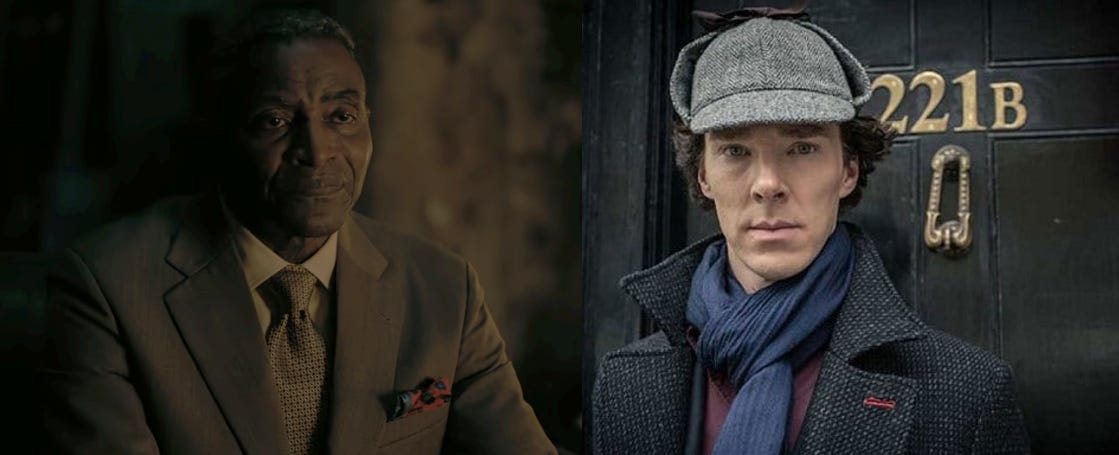
Poe WANTS you (yes, YOU!) in his story
But okay, wait. I don’t just get to completely rewrite the text! I don’t just get to decide it’s something it never was meant to be! Poe had a plan and an idea in his head, for god’s sake!
I said Reader-Response was an umbrella term. I also said we could play a game together! So let’s introduce another theorist for a sec, and see if we get to the same reading.
Curtain up for: Wolfgang Iser.
Iser has this concept of “gaps” that an author leaves in the text for his “implied reader”.
He’s not saying that the reader is going to reinvent a text. Instead, he says that the relationship between author and reader is that the author writes the framework, and leaves purposeful gaps for the reader, who will fill them with their own experiences, desires, preconceptions, etc.
This experience in the moment, that mental filling, and then disruption of what we thought we believed? That’s what Iser wants you to notice.
So what do I mean by a “gap” in this story? Easy – Poe looooves gaps. Look at how Dupin is written, when the pair finally arrive at the scene of the crime:
“We went up stairs—into the chamber where the body of Mademoiselle L’Espanaye had been found, and where both the deceased still lay. The disorders of the room had, as usual, been suffered to exist. I saw nothing beyond what had been stated in the “Gazette des Tribunaux.” Dupin scrutinized every thing—not excepting the bodies of the victims. We then went into the other rooms, and into the yard; a gendarme accompanying us throughout. The examination occupied us until dark, when we took our departure. On our way home my companion stepped in for a moment at the office of one of the daily papers.
I have said that the whims of my friend were manifold, and that Je les ménageais:—for this phrase there is no English equivalent. It was his humor, now, to decline all conversation on the subject of the murder, until about noon the next day. He then asked me, suddenly, if I had observed any thing peculiar at the scene of the atrocity.”
This is literally it.
We go into the room, which is in “disorders”, our anonymous protagonist sees nothing new, Dupin “scrutini[zes] every thing” for a long time, and then they leave.
We do not hear any detail about the room. We do not see any details of what Dupin does in the room. It’s a really striking “gap”.
Now think about how you filled it. Because you filled it, didn’t you?
Poe already told you how to, in the opening:
“The mental features discoursed of as the analytical, are, in themselves, but little susceptible of analysis. We appreciate them only in their effects. We know of them, among other things, that they are always to their possessor, when inordinately possessed, a source of the liveliest enjoyment.”
We are primed to expect the gaps; to accept “the analytical” as mentally above us. And then we are even primed on how to enjoy it: with a philosophical-sounding treatise on how we mentally engage in the games of chess and daughts.
To prime us, before Dupin does any deducting, to see him as a genius. Poe uses the authorial narration at the start to set us up to be thinking in this way, so that we don’t fill that gap with a blundering blankness, but…
Well.
Did you fill it with every detective scene you’ve ever watched on TV? Did you fill it with Sherlock from the BBC adaptation, or Poirot, or hear the Murder She Wrote theme tune?
Did Poe intend that? Obviously not. I’m not arguing that he pre-empted Poirot, or was a time-traveller. But Poirot comes from a long line of detective fiction that travelled through Holmes that travelled from Dupin. And so in doing so, you fill the gap with intellect, with deduction. Poe wants you to fill the gap. It’s written into the structure of the story. The meaning of the text isn’t all built into it, you are forced to construct some of it yourself!
the game is afoot. but let’s go further this time.
What’s another gap in this text?
Let me suggest: our anonymous narrator.
When you first started reading Rue Morgue, what did you think of them? Well, here’s a game, let’s do what Gadamer would call self-deception.
Let’s try to be our 1841 reader, just for a second. Let’s pretend we’re a big fan of Poe’s horror stories, and this is the first detective story we’ve ever read.
What might we jump to guessing?
Well, I know what I’d guess, based on Poe’s oeuvre. I’d be immediately suspicious of our unnamed narrator. Because, and I guess spoilers for some of Poe’s other great works, our narrator is PRETTY OFTEN the villain! Poe, gothic as he is, loves to investigate the psyche, and particularly the fucked-up psyche. I go into a Poe story always suspicious of the narrator.
And Poe wants you to be. Why is our narrator mysterious, friendless, and penniless?
“Indeed the locality of our retirement had been carefully kept a secret from my own former associates; and it had been many years since Dupin had ceased to know or be known in Paris. We existed within ourselves alone.”
Why is their life together, once they move in, so suspicious and dark?
“It was a freak of fancy in my friend (for what else shall I call it?) to be enamored of the night for her own sake; and into this bizarrerie, as into all his others, I quietly fell; giving myself up to his wild whims with a perfect abandon… At the first dawn of the morning we closed all the messy shutters of our old building; lighting a couple of tapers which, strongly perfumed, threw out only the ghastliest and feeblest of rays.”
On close-reading, our narrator IS suspicious. Why are these rays “ghastly”? Why is their home a “carefully kept” secret?
And yet. Within a few paragraphs my suspicion is immediately assuaged. And is this because of anything actually written in the text of the story? Anything intended by Poe? No.
It’s because our narrator is obviously Dr. Watson, the progenitor of him at least, and of course I would never be suspicious of Watson. So once again my reading of the story is unsurpassably changed, but this time in a different direction, and to deny this would be self-deception.
Any tension from the anonymity of the narrator, even if Poe intended it, is gone for me. I can’t get it back.
Perhaps it’s even replaced by homoetoticism – but is that coming from the “giving myself up to his wild whims with a perfect abandon”, or is it from years of reading Johnlock meta on Tumblr?
Rue Morgue actively exposes the limits of formalist critique because its entire structure depends on the reader anticipating something. Maybe that’s to gothically suspect our narrator. But it also opens it to filling the narrator with a different horizon, too.
This text has an afterlife, and it’s haunting itself
What did I just say? That this type of detective fiction “had never really been done before Poe”?
Let’s talk a little about horizons with respect to history.
Enter, stage right: Jauss.
I don’t just get to say that Poe invented detective fiction, do I?
Well, actually I kind of do. When Dupin was introduced to the world in Rue Morgue in 1841, mysteries did exist, but this idea of the detective as a central figure, of burying the solution until right at the end? Of, and this is of particular note to me, the admiring sidekick as narrator? This package was NEW.
I am not wrong to say that me and you approach Rue Morgue with a completely different horizon to that of the reader of 1841. Our world is different, but notably, our expectations and knowledge of the detective and crime fiction genre is wildly different. Rue Morgue must have been such a story to behold at the time.
And Now?
Well, I enjoyed it. But tell me honestly… did it feel kind of formulaic to you? Even the twist ending – the pre-empting that the reader will want a sensible, satisfying, conclusion, and then subverting that?
But it certainly didn’t feel formulaic at the time.
Poe invented that formula. And a Jaussian reading might say that our horizon of expectation is so completely different to that of the original reader, that it’s not just our individual readings of it that have changed. The text itself has a new meaning.
Rue Morgue is no longer shocking, it isn’t new. It’s what Melvyn Bragg said, earlier in this article. It is the originator of a genre.
It’s gone from uncanny to canon. Any reading today is influenced by that horizon, which is not the horizon of 1841. The text itself has been reflexively changed by its own future, and it is intellectually dishonest to pretend that it hasn’t.
Reader-response criticism isn’t some kind of postmodern misdirection, or a stupid distraction from “real” literary criticism.
It’s a vital tool to solve literature’s mysteries.
Marginalia's 2026 Oxford English Literature Personal Curriculum

A year’s worth of personal curriculum. People love suggesting them, here on Substack. Does anyone actually do them?
(it’s Holmes)